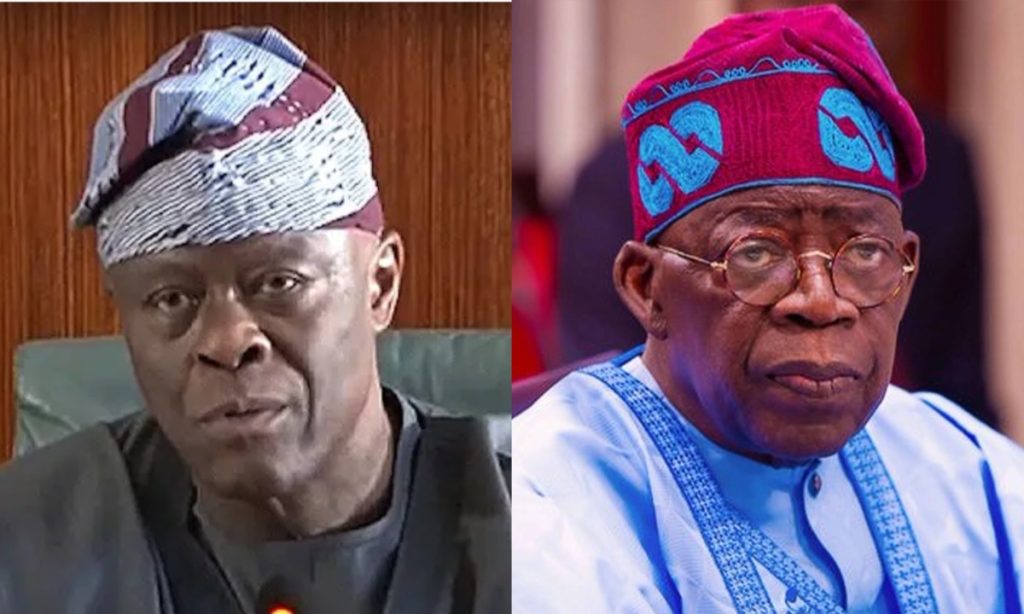
President Bola Ahmed Tinubu’s decision to relieve Wale Edun of his duties as Minister of Finance has sent mixed signals across Nigeria’s economic landscape, sparking debate among investors, analysts and market watchers.
Edun’s removal, alongside that of the Minister of Housing and Urban Development, Ahmed Muda Dangiwa, was announced in a memo by the Secretary to the Government of the Federation, Senator George Akume. Edun was directed to hand over to Taiwo Oyedele, while Dangiwa is to transfer responsibilities to Muttaqha Rabe Darma, nominated as minister-designate.
The Presidency did not state specific reasons for the changes but noted that the cabinet reshuffle was in line with the President’s constitutional powers under Sections 147 and 148 of the 1999 Constitution (as amended).
Edun had been a central figure in the administration’s “Renewed Hope” economic reforms, overseeing major policy shifts including the removal of fuel subsidy and the liberalisation of the foreign exchange market. He had previously stated that the reforms helped boost Nigeria’s GDP growth to 4.07 percent in the fourth quarter of 2025, compared to 2 percent in 2023, while inflation reportedly eased to 15 percent from 22.04 percent.
Despite these macroeconomic indicators, many Nigerians continue to grapple with high living costs, rising transportation fares and persistent food inflation, dampening the perceived impact of the reforms at household level.
The development comes amid external pressures on the economy. The International Monetary Fund recently downgraded Nigeria’s growth forecast to 4.1 percent from 4.3 percent, citing risks linked to global shocks, including tensions in the Middle East.
Edun had only just returned from the World Bank/IMF Spring Meetings in Washington, where he maintained that Nigeria would not seek a bailout from the IMF despite global headwinds and reaffirmed the government’s commitment to stable domestic policies.
His abrupt exit, however, unsettled segments of the market. Following the announcement, the naira weakened to close at N1,350.74 to the dollar. Meanwhile, equities on the Nigerian Exchange Limited recorded an N88 billion gain, significantly lower than the N609 billion recorded the previous day.
Policy Clarity Key to Investor Confidence
Reacting to the development, Professor of Accounting and Finance at Lead City University, Godwin Oyedokun, said the situation should be assessed from both strategic and economic stability perspectives.
According to him, leadership changes can sometimes reflect a government’s willingness to reassess its economic direction and inject fresh momentum into policy implementation.
“Cabinet reshuffling, in this context, should be viewed through a dual lens,” he said. “On one hand, it can signal responsiveness — a willingness by the government to recalibrate strategy and inject new energy into economic management. On the other hand, if perceived as abrupt or lacking clear justification, it risks undermining investor confidence by introducing uncertainty about policy continuity.”
Oyedokun stressed that investors are generally less concerned about personalities and more focused on the broader policy environment. He noted that coherence, predictability and credibility of economic policies remain the primary drivers of investment decisions.
He added that maintaining policy stability, communicating clearly with stakeholders and strengthening institutions would be more critical to sustaining investor trust than any single appointment.
As Nigeria navigates both domestic reforms and external economic pressures, analysts say the government’s next steps — particularly in clarifying policy direction under the new finance leadership — will determine whether the reshuffle restores confidence or deepens uncertainty in Africa’s largest economy.
About The Author