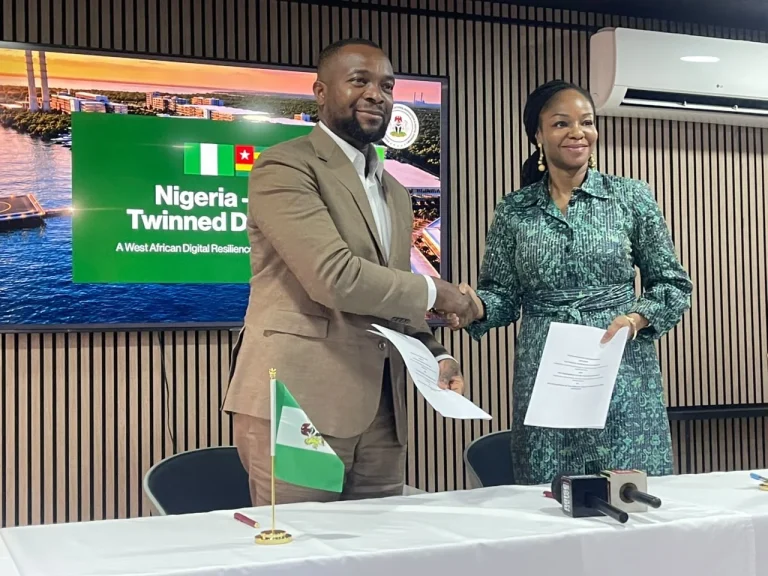
Nigeria and Togo have signed a memorandum of understanding to establish two interconnected data parks in a joint effort to attract international investors and strengthen digital infrastructure across West Africa.
The agreement was signed in Lagos on Thursday by Nigeria’s Minister of Communications, Innovation and Digital Economy, Dr Bosun Tijani, and his Togolese counterpart, Cina Lawson.
The project is expected to begin in the second quarter of 2027, subject to the completion of necessary preparations.
The proposed data parks will provide shared infrastructure, including reliable electricity, fibre-optic connectivity, serviced land and cooling facilities, allowing multiple companies to establish and operate data centres.
Unlike standalone data centres, which house servers for storing and processing digital information, data parks provide the essential infrastructure needed by several operators within a designated location.
Under the agreement, Nigeria and Togo will develop separate but interconnected facilities through a joint special purpose vehicle. Both governments will hold equity in the arrangement alongside private companies and investors.
Speaking at the signing ceremony, Tijani explained that the financing structure was designed to attract private investment and ensure that the governments would not bear the entire cost of developing the facilities.
He said both countries would participate in the joint investment vehicle while opening the project to private sector partners.
“The way this has been structured is that it’s going to be a special purpose vehicle where the government will have equity in the vehicle, a single vehicle. Both the Nigerian government and Togo’s government will have equity in it. But we will also have private companies and investors who would join us in that vehicle,” he said.
The minister added that the governments would concentrate on providing regulatory support and creating favourable conditions to attract international data centre operators.
“We will crowd in investment to ensure that the government is not just paying for this. I think the biggest contribution for the government is on the regulation side, because we want the park to be as attractive as possible,” he stated.
On her part, Lawson described the agreement as the first joint digital infrastructure project between Nigeria and Togo, noting that it demonstrated the potential of regional cooperation in delivering large-scale investments.
She said the partnership would help attract businesses and customers from both English-speaking and French-speaking countries across West Africa.
According to her, combining Nigeria’s English-speaking market with Togo’s French-speaking market would give the project a wider regional reach.
“This collaboration is also significant because Togo is a French-speaking country, Nigeria is an English-speaking country, and so what we want to do is that we want to be able to attract both French-speaking and English-speaking countries,” Lawson said.
Lawson also stressed that the initiative would not be restricted to the two countries, adding that other West African nations would be welcome to participate.
“The two countries, Togo and Nigeria, we’re starting, but this project is open to all of West Africa actually,” she said.
The Togolese minister linked the partnership to her country’s ongoing fibre-optic expansion programme, which is targeting connectivity for 2,700 schools, 250 hospitals and all districts across Togo.
She further disclosed that discussions had taken place on the possibility of developing artificial intelligence data centres under the partnership in the future.
According to her, Africa should position itself to benefit from the growing global demand for computing infrastructure driven by artificial intelligence.
On the proposed locations, Nigeria is considering a site adjoining the Egbin Power Station in Lagos State, while Togo is still assessing possible locations for its facility.
Tijani said the two data parks were expected to become operational around the same period, although Togo had yet to finalise its preferred site.
He explained that the Egbin location was being considered because of its proximity to electricity generation infrastructure, access to gas and water resources for cooling, as well as potential connections to fibre-optic and submarine cable networks.
The minister said the broader ambition was to develop facilities capable of attracting operators serving international markets rather than limiting their services to West Africa.
“We’re not seeing a park that is just for data centres that wants to serve our region. We think we can actually compete globally. There’s growing appetite for more data centres globally. We think West Africa, particularly Nigeria and Togo, can provide a home for attractive data centres,” he said.
The partnership comes amid Nigeria’s efforts to expand its domestic cloud computing and data hosting capacity as demand for digital services, artificial intelligence and online transactions continues to grow.
In August, the Federal Government unveiled its National Digital Cloud Policy, with a target of 750m within 24 months to support the development of Nigeria’s cloud and data infrastructure ecosystem.
The policy is expected to encourage local and international companies to invest in data centres, cloud services and artificial intelligence computing facilities, while strengthening Nigeria’s ambition to become a major digital services hub in Africa.
About The Author