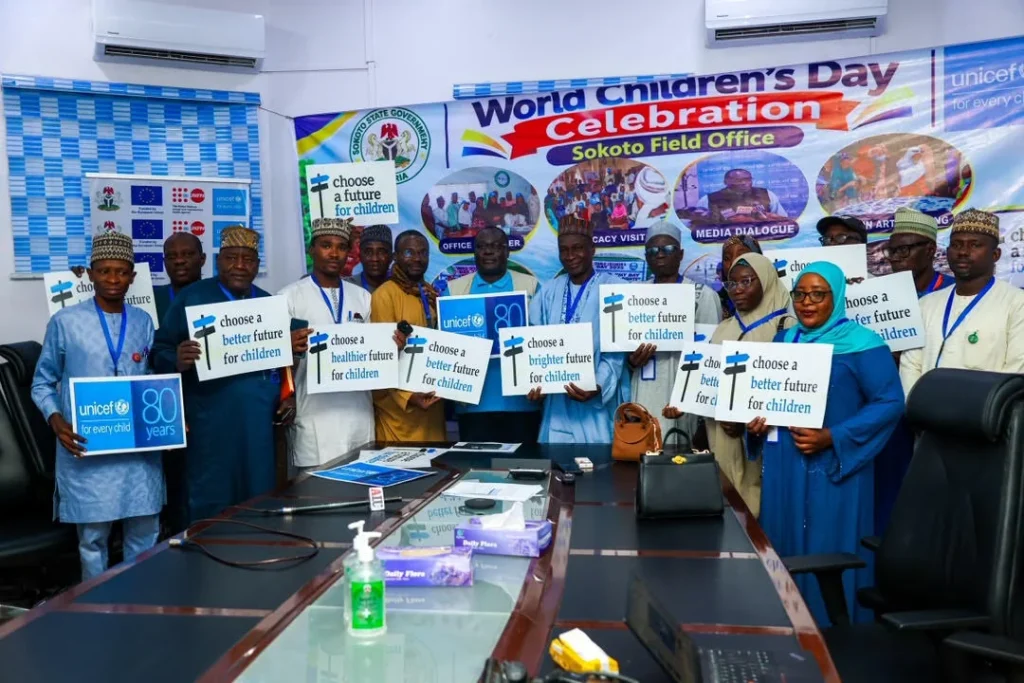
About 624,000 children in Sokoto, Kebbi and Zamfara states have been identified as out of school, UNICEF says. So far, only 68,000 of them have been reached through its school re-enrolment efforts. The agency shared the figures on Friday at a media briefing in Sokoto marking World Children’s Day 2026, whose theme is “My Day. My Rights. My Future.” Dr Michael Juma, who heads UNICEF’s Sokoto Field Office, said the gap between the children identified and those reached shows the need for stronger government commitment, more investment and more community involvement. By my arithmetic, that’s roughly 11 per cent reached.
Education work goes beyond re-enrollment. About 98,000 children across the three states have benefited from the Teaching at the Right Level programme, which focuses on basic reading and numeracy. UNICEF also supports teacher training, learning materials, accelerated basic education, integrated Qur’anic education and alternative platforms such as radio lessons and the Nigeria Learning Passport. Juma admitted that the hardest part is still getting identified out-of-school children into classrooms.
On health, he said about 7.8 million children were reached in measles-rubella vaccination campaigns across the three states, and more than five million received polio vaccines in the last campaign. In Kebbi, roughly 148,000 children have had the first dose of the malaria vaccine and 130,000 the second. He praised state governments for putting up money. Sokoto committed N100m and Zamfara N500m to buy ready-to-use therapeutic food for children with severe acute malnutrition, and Kebbi put about N540m toward free medical care for children. UNICEF-backed social health insurance has about 86,000 beneficiaries in Zamfara, 18,000 in Sokoto and 10,000 in Kebbi. UNICEF has also helped develop child protection laws, Family Court Rules and social protection policies for vulnerable children, including those in conflict with the law.
He addressed two worries directly. Global funding is falling, he said, but that’s not just a Nigerian problem. UNICEF is looking for more resources, and he said education programs in the three states weren’t affected by the funding cuts earlier in the year. On insecurity and hard-to-reach communities, he said UNICEF works through government structures, field facilitators and third-party monitoring so that vulnerable children and women still get essential services.
Part of his message was for the press. Juma asked journalists for balanced reporting that highlights progress while also pointing out the gaps. “We want journalists to use their platforms to enlighten communities, generate demand for essential services, highlight emerging challenges and hold stakeholders accountable for their commitments towards children,” he said. He invited media organizations on future field visits to see UNICEF-backed work in education, nutrition, health and social protection. The next polio immunization campaign runs from December 5 to 11 across Sokoto, Kebbi and Zamfara, and UNICEF asked reporters to help get parents and caregivers to bring eligible children.
About The Author