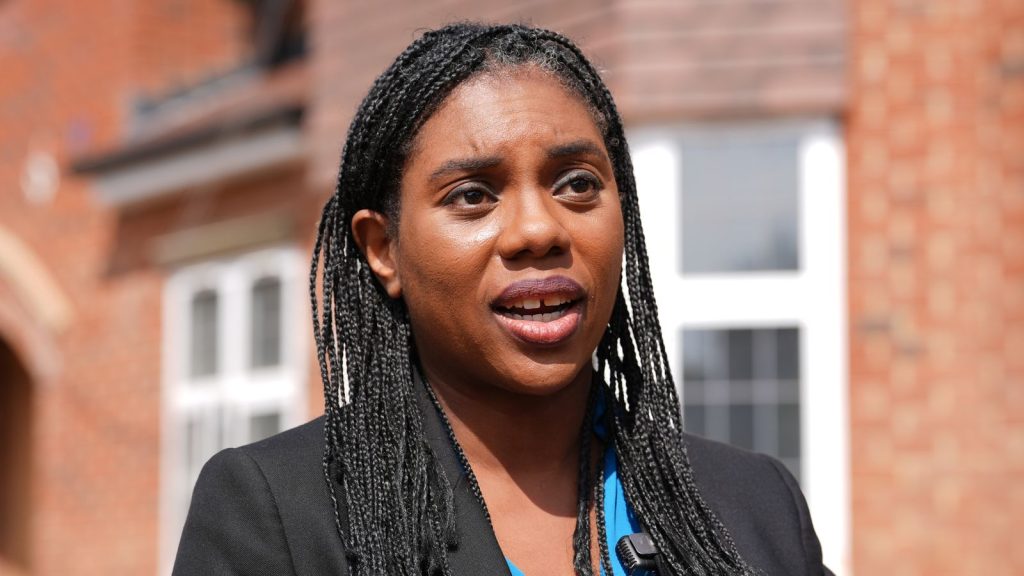
LONDON — Kemi Badenoch, the leader of the United Kingdom’s Conservative Party, has cited Nigeria’s persistent power crisis as a cautionary tale of how poor governance can ruin a resource-rich nation, warning the UK against taking a similar path.
Speaking in a recent interview with The Spectator, Badenoch, who spent part of her childhood in Nigeria, argued that the country’s vast oil wealth has failed to translate into reliable electricity due to decades of counterproductive state interventions.
The Failure of Resource Wealth Reflecting on how her upbringing in Nigeria shaped her free-market political philosophy, the British politician emphasized that natural resources are useless without the right economic framework.
“My belief that we need to drill our oil and gas comes from growing up in a country… Nigeria is an oil-producing country, never had electricity,” Badenoch said. “It is very easy to have resources under the ground, but stupid public policy means that you can’t use it.”
Comparing UK Energy Policy to Nigerian Dictatorships Badenoch used her childhood experiences to launch a fierce critique against the current UK government, specifically drawing parallels between Ed Miliband, the UK Secretary of State for Energy Security and Net Zero, and Nigeria’s past military regimes.
“And I see quite a lot of what Ed Miliband is doing as being very much like what the Nigerian military dictatorships were doing in the 80s and 90s — ‘the government is going to take control, we know what’s best, we’re going to redistribute’,” she stated. “Stupid ideas which eventually just bankrupt the country.”
A Warning Against the Decline of British Wealth The Conservative leader noted that witnessing severe poverty firsthand gave her a unique perspective on governance, urging British citizens not to take their institutional wealth and history for granted.
“Fundamentally, my views about how we should run our country come from growing up in a place that was very poor. You grow up in a third-world country and you look at why it is termed ‘third world,’ and I don’t want that to happen here,” she added, calling for stronger efforts to preserve British culture and economic stability.
About The Author