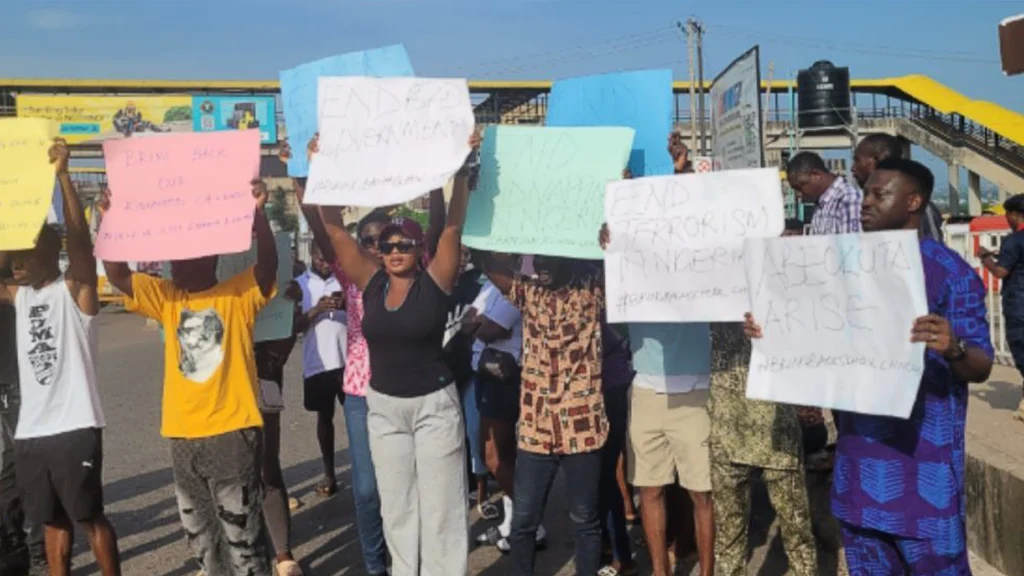
The abduction of dozens of pupils and teachers from schools in Oriire Local Government Area of Oyo State has triggered widespread outrage across Nigeria, prompting nationwide protests by teachers, condemnation from lawmakers, and renewed calls for the establishment of state police as part of broader security reforms.
The protests, coordinated by the Nigeria Union of Teachers (NUT) and supported by labour unions and civil society groups, took place across the Federal Capital Territory and several states, including Lagos, Edo, Rivers, Cross River, Benue, Adamawa, Taraba, Anambra, Akwa Ibom, Abia, Osun, Niger, Kano, and Ogun.
The incident occurred on May 15 when heavily armed men attacked three schools in the Ahoro-Esinle and Yawota communities of Oriire Local Government Area, abducting pupils and teachers and leaving families devastated. The attack has been described as one of the most significant school kidnappings in recent years, reviving painful memories of previous mass abductions in Chibok and Dapchi.
As the Senate resumed plenary following the Sallah break, lawmakers observed a one-minute silence in honour of two teachers and a pupil who lost their lives in connection with the attack.
President of the Senate, Godswill Akpabio, described the abduction as a direct assault on Nigeria’s future and collective humanity.
According to him, children and teachers represent the foundation upon which the nation’s progress is built, warning that a country unable to protect its young people risks undermining its future.
Akpabio paid tribute to mathematics teacher Michael Oyedokun, who reportedly died while in captivity, teacher Adesiyan Adegboye, who was killed during the attack, and a pupil who also lost his life.
He expressed sympathy with the bereaved families and stressed that the tragedy was a national loss.
Despite the grief, the Senate President expressed confidence that security agencies would eventually secure the release of those still being held by their captors. He also urged politicians to avoid exploiting the tragedy for political gain, emphasizing that criminals target Nigerians regardless of political affiliation, religion, or ethnicity.
The attack occurred amid growing concerns over insecurity in schools across the country. Between May 13 and May 15, no fewer than 82 pupils were abducted in separate attacks in Oyo and Borno states.
In Borno State, 42 pupils were kidnapped during attacks on schools in Askira Uba and Chibok Local Government Areas. In Oyo State, another 40 pupils were abducted during coordinated attacks on Baptist Nursery and Primary School, Community Grammar School, and L.A. Primary School.
The House of Representatives also weighed in on the crisis, calling on the Federal Government and security agencies to immediately secure the release of pupils abducted in Borno State while demanding urgent implementation of a comprehensive national Safe Schools Security Framework.
The resolution followed a motion sponsored by Hon. Midala Balami, who warned that repeated attacks on schools were undermining access to education and weakening public confidence in the government’s ability to provide security.
Lawmakers stressed that protecting schools, pupils, and teachers remains one of the government’s most important responsibilities and called for stronger intelligence gathering, rapid-response security operations, and community-based policing mechanisms.
The issue of state policing also dominated discussions in the House of Representatives.
Hon. Ayodeji Alao-Akala, representing Ogbomoso North, Ogbomoso South and Oriire Federal Constituency, urged the Federal Government to decentralise policing, arguing that communities affected by insecurity require locally driven security solutions.
He lamented the continued attacks on communities around Ogbomoso and Oriire and described the reported beheading of Michael Oyedokun in captivity as a barbaric act that demands decisive action.
Alao-Akala further warned that forests surrounding the Old Oyo National Park had become safe havens for criminal groups operating across state borders and international routes.
In Abuja, teachers converged at the Federal Capital Territory Administration Secretariat, where FCT Minister Nyesom Wike assured protesters that security agencies were working to secure the release of all abducted victims.
Wike expressed confidence in the country’s security institutions and urged Nigerians not to politicise the issue, describing insecurity as a challenge that affects all citizens.
The protests also reached Lagos, where teachers marched to the Lagos State House of Assembly. Speaker Mudashiru Obasa reiterated support for the creation of state police, arguing that localised security structures would improve responses to emerging threats.
In Ibadan, Oyo State Governor Seyi Makinde described the abduction as a moment of national distress requiring unity and collective action rather than political blame.
Makinde told protesters that security personnel had been deployed and were working with intelligence agencies to locate the victims and secure their release. He urged citizens not to allow criminals to create division among Nigerians.
Across several states, labour unions and teachers intensified pressure on the government.
In Ogun State, protesters carried placards bearing messages such as “Release Our Teachers and Learners Unconditionally” and “Nigeria, Our Blackboards Are Turning Into Graveyards.”
The National Vice-President of the NUT, Titilope Adebanjo, warned that insecurity was threatening the future of education in Nigeria, noting that both teachers and pupils now attend schools under fear.
Similarly, the Ogun State Chairman of the Nigeria Labour Congress, Hameed Benco, warned that organised labour could escalate its actions if authorities failed to secure the release of the abductees.
In Edo State, teachers marched through Benin City carrying placards with messages including “Teachers’ Lives Matter” and “Bring Back Our Teachers in Oyo.”
The Edo NUT Chairman, Lucky Imaruagheru, criticised what he described as government inaction and called on leaders to fulfil their responsibility of protecting citizens.
Teachers in Benue, Adamawa, Kano, Niger and other states also joined the protests, demanding stronger protection for schools and the immediate rescue of abducted pupils and teachers.
Meanwhile, private school proprietors under the National Association of Proprietors of Private Schools in Ogbomoso intensified advocacy efforts and pledged continued engagement with stakeholders until all victims are safely reunited with their families.
The atmosphere of anxiety surrounding school safety also spread to neighbouring Osun State, where rumours of an impending bandit attack triggered panic and forced some schools to suspend activities temporarily.
However, Governor Ademola Adeleke later dismissed the reports as false and assured residents that schools remained safe. He said additional security measures were being implemented, including the deployment of refurbished armoured vehicles.
Amid the growing national concern, the Nigeria Police Trust Fund appealed to the Senate for an increase in its statutory funding allocation from 0.5 per cent to one per cent. Executive Secretary Mohammed Sheidu said additional funding would support the acquisition of drones, surveillance technology, forensic laboratories, and advanced digital intelligence tools needed to combat kidnapping, terrorism, and organised crime.
The nationwide protests and renewed calls for state policing underscore mounting public frustration over persistent attacks on schools and communities, as Nigerians continue to demand stronger security measures to protect lives, safeguard education, and restore public confidence in the country’s security system.
About The Author